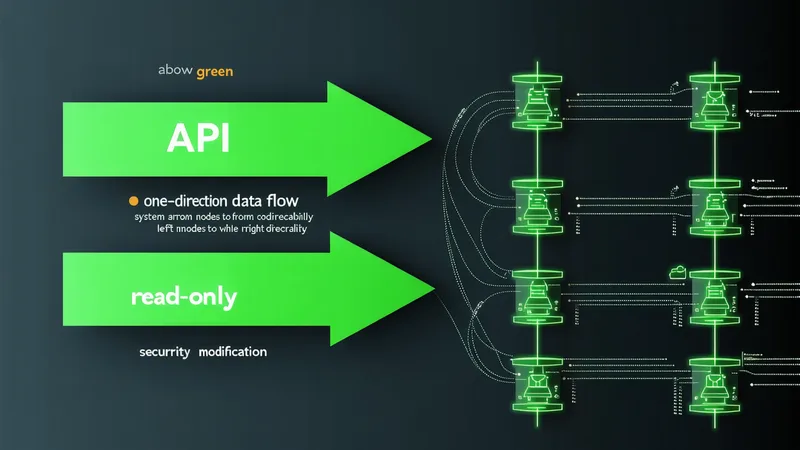
There is a straightforward security principle that applies to any tool connecting to your production systems: the minimum necessary access to accomplish the legitimate purpose. For a compliance monitoring tool, that purpose is observation — reading system state, collecting evidence, validating control posture. Write access is not required for any part of that function. If a compliance tool is asking for write permissions, it's asking for something it doesn't need.
This sounds obvious when stated plainly. In practice, the market is not uniform on this point. Some compliance automation products request scopes that include write access to identity providers or cloud environments. Some request OAuth grants that cover significantly more than observation. The architectural question of what access model a compliance tool uses is worth asking explicitly, because the implications extend well beyond the tool's own security posture.
Why write access creates a material security risk
When you grant a third-party tool write access to your Okta tenant, your AWS IAM environment, or your GitHub organizations, you are creating a privileged access path that must be secured, audited, and governed as part of your own access control program. That access path is subject to several categories of risk that don't exist with a read-only integration.
Credential compromise is the most direct. If the compliance tool's infrastructure is breached and the stored OAuth tokens or API keys are exfiltrated, an attacker now has write access to the same systems the tool has write access to. For an Okta integration with provisioning scopes, that means the ability to create users, modify group memberships, and potentially bypass MFA requirements. For an AWS integration with write scopes, the blast radius depends on what policies are attached to the role — but write access to IAM is write access to essentially everything in that account.
Accidental modification is a second category. Tools that request write access for "remediation" features — automatically revoking users, automatically adjusting configurations to match a policy baseline — can cause production incidents. A remediation action triggered by a false positive, a misconfigured policy rule, or a race condition with another automation can remove access for legitimate users, alter security group configurations, or modify IAM policies in ways that break production services.
Scope creep in grant review is a third, subtler risk. When security teams review third-party integrations for their own SOC 2 evidence, they look at what permissions are granted and to whom. A compliance tool with write access to production systems creates an awkward answer to the question "who has write access to your production IAM environment?" — specifically, it's a third-party SaaS vendor you're paying to help with compliance. This is a genuine complication in vendor risk assessments and access reviews.
What read-only architecture actually requires
A read-only compliance integration, implemented correctly, requires a distinct set of OAuth scopes or IAM permissions that covers only the specific data needed for control monitoring. For an AWS integration, this means something like the AWS SecurityAudit managed policy or a tightly scoped custom policy covering only read operations — not iam:CreateUser, not iam:AttachRolePolicy, not ec2:AuthorizeSecurityGroupIngress. For an Okta integration, it means read-only scopes covering users, groups, applications, and logs — not the provisioning API scopes that allow user creation or attribute modification. For GitHub, it means read:org, read:user, repo in read mode — not admin scopes.
The minimal-scope principle applies at every integration point. When a compliance monitoring system needs to read your CloudTrail logs, it needs access to the S3 bucket where logs are stored — but not write access to that bucket, not the ability to modify the CloudTrail configuration, and not admin access to the account. When it needs to read your GitHub organization membership, it needs read:org — not the ability to add or remove members.
Implementing this correctly also means that the OAuth grant review process becomes a first-class engineering activity, not a compliance checkbox. Before connecting any integration, the compliance team and the security or platform engineering team should review the specific scopes being requested and confirm that each scope maps to a specific monitoring function. "Read access to your identity provider" is not a sufficient description — the specific scopes need to be documented and justified.
The connection to your own SOC 2 controls
Here is the point that compliance teams often miss: the access model you use for your compliance monitoring tool is itself within scope for your SOC 2 program. Specifically, CC6.1 (logical access restricted to authorized users) and CC6.3 (system access restricted to prevent unauthorized access) both apply to the integrations you've established with your compliance tool.
If your compliance tool has write access to your Okta environment, then that write access needs to appear in your user access review. The access needs to be justified against a business need. The principle of least privilege needs to be demonstrably applied. Your auditor will look at your third-party application integrations, and a compliance tool with write access to production systems requires more justification than a compliance tool with read-only access.
There's also an AICPA AT-C 205 consideration for organizations that are themselves service organizations — meaning your customers rely on your systems for their own compliance programs. If you're a SaaS company that processes data for customers who have their own SOC 2 programs, the security of your own infrastructure, including the access you've granted to third-party tools, is part of the trust chain your customers are relying on. A compliance tool with write access to your production environment is a fact that matters to your customers' auditors, not just your own.
Evaluating compliance tools: the access model question
When evaluating compliance monitoring tools, there are specific questions worth asking explicitly rather than inferring from marketing copy.
For each integration the tool supports: what specific OAuth scopes or IAM permissions are required? Does the tool request any write, create, update, or delete scopes? Are there any integration modes that require admin-level access? Can the integration function fully with the minimal read scopes, or are some features only available with elevated permissions?
We're not suggesting that a tool requesting write access is necessarily a bad tool — some compliance automation products have legitimate remediation features that require write access and implement them with appropriate safeguards. But the access model should be an explicit, documented part of the vendor evaluation, not an implicit assumption. If a vendor can't tell you exactly which scopes their integration requests and why each one is necessary, that's a gap in their own security posture documentation.
Read-only as a design philosophy, not just a feature
The argument for read-only access isn't purely defensive. There's an architectural reason why a compliance monitoring tool built from the start on read-only API access is more reliable than one that started with write access and later constrained it.
A read-only architecture forces the tool to observe and report rather than to act. That constraint shapes product design in ways that improve reliability: the tool can't accidentally modify the system state it's trying to observe, so its observations are pure. The evidence it collects is unambiguous — it's a reading of the system's state, not a state the tool itself influenced. This matters particularly for audit evidence: an auditor evaluating control state needs confidence that the evidence reflects actual system behavior, not behavior that was partially produced by the monitoring tool.
Read-only access also simplifies the trust relationship with your team. Security and platform engineers who need to approve integration access grant requests are significantly more comfortable approving read-only scopes than write scopes. Approval cycles are shorter, scope creep reviews are simpler, and the ongoing governance burden is lower. Over a multi-year compliance program, that difference in friction accumulates.
The compliance monitoring market will continue to evolve, and features will become more sophisticated. But the read-only principle is architectural, not a feature — it should be a baseline expectation for any tool you connect to your production systems, not a differentiator you have to search for.